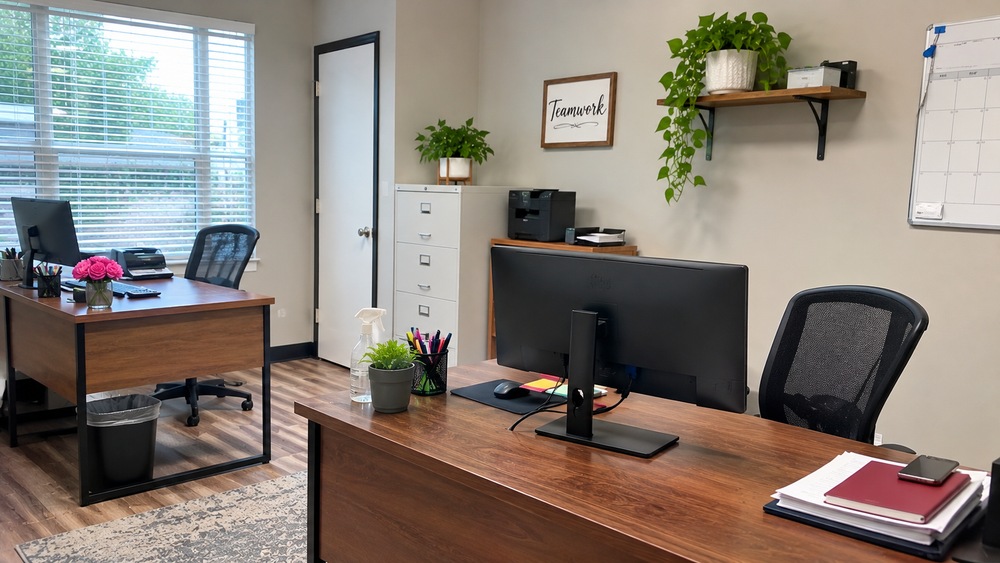
It's 6:10 PM in a small office in Marietta.
The last employee has gone home.
The computers are still on, a few folders remain open on the desks, and someone's coffee mug is sitting beside a keyboard.
There are fingerprints on the conference table.
The floor near the printer has collected a little debris.
And the shared workstations show the ordinary signs of a full business day.
At first glance, it looks like a straightforward cleaning job.
But an office is not simply a collection of furniture.
Every desk can contain documents, electronics, equipment, and belongings that matter to the person who uses it.
That introduces an important difference between cleaning a workplace and simply wiping down every visible surface.
The most effective commercial cleaning plans respect both the physical space and the work happening inside it.
A Desk Has More Than One Kind of Surface
Consider a typical workstation.
There is the desktop itself.
A computer monitor.
A keyboard and mouse.
Perhaps a telephone, notebook, charging cable, and several personal belongings.
Although these objects occupy the same small space, they shouldn't automatically receive the same cleaning treatment.
A laminated desk surface may tolerate ordinary cleaning products intended for that material.
A computer screen may require a manufacturer-approved cleaning method.
And papers or personal electronics may need to remain exactly where the employee left them.
This is why commercial cleaning should begin with clear boundaries.
Which surfaces are included?
Are electronics to be cleaned, or should they be left untouched?
Can small objects be moved?
Are there restricted workstations?
These details help establish what is appropriate before the team begins working.
The Paperwork Problem
One of the simplest ways to create trouble in an office is to move documents without knowing what they are.
A folder may contain information needed for the following morning.
A stack of papers might be arranged in a particular order.
A notebook could contain confidential client information.
To someone unfamiliar with the business, these objects may look like ordinary desk clutter.
To the employee responsible for them, their exact placement may matter.
That's why professional office cleaning should never be confused with document organization.
A cleaning team should not discard, rearrange, or examine business documents without clear authorization.
If the desktop needs attention, employees can secure sensitive paperwork before the scheduled visit.
Alternatively, certain areas may be excluded from cleaning.
The correct approach depends on the workplace and the agreed service.
A clean office should never come at the expense of misplaced files or compromised confidentiality.
The Shared Printer Station
Now consider an area that nearly everyone in an office uses.
The printer station.
It's where people collect documents, replace paper, retrieve supplies, and occasionally leave things behind.
Because employees approach it throughout the day, the surrounding area can receive more traffic than an individual workstation.
The nearby floor may collect loose debris.
Accessible shelves can accumulate dust.
And the exterior of frequently handled equipment may show ordinary fingerprints.
But there is an important distinction between cleaning around office equipment and servicing the equipment itself.
Printers and similar devices have specific manufacturer instructions.
Cleaning liquids should not be sprayed directly into electrical openings.
Internal printer mechanisms should not be disturbed as part of routine office cleaning.
Any maintenance involving toner, mechanical components, or electrical issues should follow the manufacturer's procedures or be handled by an appropriate technician.
For a commercial cleaning company, understanding those boundaries is part of respecting the property.
The objective is to maintain the agreed surrounding surfaces without interfering with how the equipment operates.
The Conference Room: One Table, Many Users
A conference room provides a different kind of challenge.
Unlike an individual desk, the same table may be used by several groups throughout the week.
Someone arrives with a laptop.
Another person brings a coffee.
A meeting ends, the chairs are moved, and the room remains empty until the next appointment.
Over time, the table may collect fingerprints and ordinary residue.
Chair arms may receive repeated contact.
And the floor around the table may accumulate debris.
A practical cleaning plan considers the surfaces that are actually used.
But it also accounts for the materials.
Glass conference tables require different care from finished wood or certain laminate surfaces.
Fabric chairs shouldn't be treated like plastic seating.
And expensive audiovisual equipment should be handled only under agreed instructions.
There's no reason to make every conference room look like a luxury corporate showroom.
It simply needs appropriate attention based on its condition, materials, and frequency of use.
Three Different Decisions Before Cleaning a Workstation
Not every visible object should be treated in the same way.
For office managers, it can help to divide tasks into three categories.
Routine attentionConfirm instructions firstUsually leave untouched unless authorizedAccessible floorsComputer screensConfidential paperworkAppropriate desk surfacesKeyboards and telephonesPersonal belongingsEmpty meeting tablesSpecialized equipmentLocked storageGeneral accessible trimDelicate finishesConnected cables and equipment
These aren't universal rules for every commercial cleaning appointment.
They're a useful starting point for discussing the scope of work.
A particular business may have different requirements based on its equipment, confidentiality policies, and operating procedures.
The important thing is to establish expectations rather than make assumptions.
What Changes at the End of the Year?
November and December can bring additional activity to certain offices throughout Metro Atlanta.
Some companies are completing projects before the holidays.
Others are preparing annual reports, scheduling meetings, or managing seasonal customer demand.
That doesn't necessarily mean the entire office needs more intensive cleaning.
But it may affect which areas receive the most use.
A conference room that's normally occupied twice a week might suddenly host several meetings in one afternoon.
A shared workspace might receive more visitors.
And the floor near a main entrance may require more frequent attention as employees move between outdoor conditions and interior work areas.
Business owners can use these patterns to help determine appropriate cleaning priorities.
For example, an office in Kennesaw with relatively few visitors may have different requirements from a busy customer-facing location in Marietta.
A routine developed for one property shouldn't automatically be applied to another without considering those differences.
Scheduling Is Part of the Service
Not every business operates on the same schedule.
Some offices close at five.
Others have employees working into the evening.
A small professional practice may require quiet during appointments.
And certain workspaces cannot be accessed while sensitive business activities are taking place.
This is one reason commercial cleaning arrangements should include a conversation about timing.
At Orderly Spaces LLC, we offer Commercial Cleaning for offices, retail properties, and other business spaces throughout Kennesaw, Marietta, Acworth, Woodstock, and surrounding Metro Atlanta communities.
Our commercial service allows clients to discuss cleaning schedules and confirm the rooms and tasks that need attention.
The exact appointment time, access arrangements, and service scope should be agreed upon before work begins.
For business owners, that communication helps avoid unnecessary interruptions.
For cleaning professionals, it provides a clearer understanding of what needs to be done.
The Difference Between Looking Professional and Being Maintained
A workplace can look impressive in photographs.
Modern desks.
Comfortable chairs.
Beautiful flooring.
Carefully chosen lighting.
But appearance alone doesn't tell you how well a space is maintained.
A modest office with ordinary furniture can be carefully cleaned.
A luxurious office can have overlooked surfaces and unclear maintenance responsibilities.
The size or cost of the furniture doesn't determine the quality of the cleaning routine.
What matters is whether the surfaces receive appropriate care, the equipment is respected, and the agreed tasks are completed consistently.
This is particularly important in offices where several employees share the same spaces.
Consistency matters more than an occasional dramatic transformation.
The Office Should Be Ready for Work, Not Rearranged for a Photograph
Imagine returning to that Marietta office the following morning.
The conference table has been appropriately cleaned.
Accessible flooring has received attention.
The agreed shared surfaces have been refreshed.
The equipment is where employees expect to find it.
And the important documents remain exactly where they were left.
That's a useful result.
Not because the office looks completely different.
But because it remains a functional workplace that has been properly maintained.
At Orderly Spaces LLC, we understand that commercial properties are working environments, not empty rooms waiting to be cleaned.
They contain important equipment, daily routines, and business responsibilities.
Professional cleaning should account for those realities.
For companies throughout Cobb County and Metro Atlanta, the starting point is a clear conversation about the property, the cleaning priorities, and the expectations of the people who use it.
Because a well-maintained office isn't one where everything has been moved and polished. It's one where the workplace has been cared for without getting in the way of the work.